CHAPTER 12: AMERICAN SYMBOLS AND HOLIDAYS
CAPÍTULO 12: SÍMBOLOS Y FERIADOS AMERICANOS
NOTE: click on red numbers to see related questions from the 2025 citizenship test.
NOTA: haga clic en los números rojos para ver las preguntas relacionadas del examen de ciudadanía de 2025.
[p69]
In this chapter, you will learn about:
- The Statue of Liberty.
- The American flag.
- The national anthem.
- National holidays that have special meaning in the United States.
Note: the 2025 Study Guide does NOT include the information
about the national motto of the United States, which is E pluribus
unum.[q124]
PLEASE KNOW THIS ANSWER.
Nota: la Guía de estudio de 2025 NO
incluye la información sobre el lema nacional de los Estados Unidos, que es
*E pluribus unum*.[q124]
POR FAVOR, memorice esta respuesta.
[p69]
En este capítulo, aprenderá sobre:
- La Estatua de la Libertad.
- La bandera americana.
- El himno nacional.
- Los feriados nacionales que tienen un significado especial en los Estados Unidos.
AMERICAN SYMBOLS / SÍMBOLOS AMERICANOS
The Statue of Liberty / La Estatua de la Libertad
The Statue of Liberty is a famous symbol of the United States. In 1886, France gave the statue to the United States as a symbol of friendship.
It is a symbol of freedom and democracy. The Statue of Liberty is in New York Harbor on Liberty Island.[q120] Every year, over 4 million people from around the world visit the Statue of Liberty.
The statue is of a woman holding a torch in her right hand and a tablet in her left hand. The tablet has the date July 4, 1776, on it. July 4, 1776, is when the Declaration of Independence was adopted.[q79]
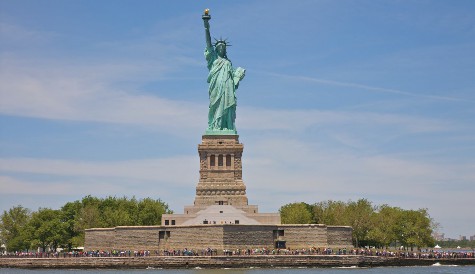
[Photo: Statue of Liberty. Courtesy of the Library of Congress.]
La Estatua de la Libertad es un famoso símbolo de los Estados Unidos. En 1886, Francia le dio la estatua a los Estados Unidos como símbolo de amistad.
Es un símbolo de libertad y democracia. La Estatua de la Libertad está en el puerto de Nueva York en la Isla de la Libertad. Cada año, más de 4 millones de personas de todo el mundo visitan la Estatua de la Libertad.
La estatua es de una mujer que sostiene una antorcha en su mano derecha y una tableta en su mano izquierda. La tableta tiene la fecha del 4 de julio de 1776. El 4 de julio de 1776 es cuando se adoptó la Declaración de Independencia.
[Foto: Estatua de la Libertad. Cortesía de la Biblioteca del Congreso.]
Ellis Island / La Isla Ellis
[p70]
Ellis Island was an immigration station in New York Harbor. Ellis Island began receiving immigrants to the United States on January 1, 1892. Over the next 62 years, more than 12 million immigrants arrived in the United States through Ellis Island. Currently the Statue of Liberty and Ellis Island are National Historic Sites. For more information on the Statue of Liberty and Ellis Island, please visit: nps.gov/stli.
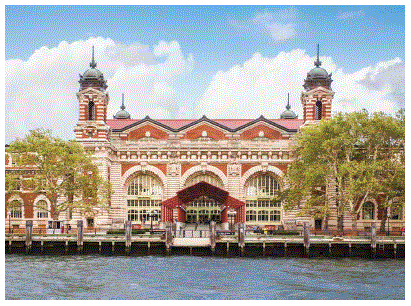
[Photo: Immigration station at Ellis Island.]
[Photo: Great Hall at Ellis Island immigration station.]
[p70]
La Isla Ellis fue una estación de inmigración en el puerto de Nueva York. La Isla Ellis comenzó a recibir inmigrantes a los Estados Unidos el 1 de enero de 1892. Durante los siguientes 62 años, más de 12 millones de inmigrantes llegaron a los Estados Unidos a través de la Isla Ellis. Actualmente la Estatua de la Libertad y la Isla Ellis son Sitios Históricos Nacionales. Para más información sobre la Estatua de la Libertad y la Isla Ellis, por favor visite: nps.gov/stli.
[Foto: Estación de inmigración en la Isla Ellis.]
[Foto: El Gran Salón en la estación de inmigración de la Isla Ellis.]
Angel Island / La Isla Ángel
Angel Island was another important immigration station on the West Coast. The Pacific Ocean is on the West Coast of the United States. Between 1910 and 1940, Angel Island processed nearly 1 million immigrants that crossed the Pacific Ocean. Many Asian Americans can trace their family history through Angel Island.
[Photo: Immigration Station on Angel Island.]
La Isla Ángel fue otra importante estación de inmigración en la Costa Oeste. El Océano Pacífico está en la Costa Oeste de los Estados Unidos. Entre 1910 y 1940, la Isla Ángel procesó a casi 1 millón de inmigrantes que cruzaron el Océano Pacífico. Muchos americanos asiáticos pueden rastrear su historia familiar a través de la Isla Ángel.
[Foto: Estación de inmigración en la Isla Ángel.]
The American Flag / La Bandera Americana
[p71]
The American flag is an important symbol of the United States. Like the Statue of Liberty, it is also a symbol of freedom. The colors of the flag are red, white, and blue. Each color on the flag has a meaning:
- Red is a symbol for bravery.
- White is a symbol for purity.
- Blue is a symbol for justice.
The flag has 13 red and white stripes. The stripes represent the 13 original colonies.[q121]
There are 50 stars on the flag. Each star represents a state.[q122]
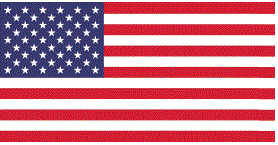
[Illustration: The American flag.]
[p71]
La bandera americana es un símbolo importante de los Estados Unidos. Al igual que la Estatua de la Libertad, también es un símbolo de libertad. Los colores de la bandera son rojo, blanco y azul. Cada color en la bandera tiene un significado:
- El rojo es un símbolo de valentía.
- El blanco es un símbolo de pureza.
- El azul es un símbolo de justicia.
La bandera tiene 13 franjas rojas y blancas. Las franjas representan las 13 colonias originales.
Hay 50 estrellas en la bandera. Cada estrella representa un estado.
[Foto: La bandera americana.]
The Pledge of Allegiance / El Juramento de Lealtad
We show loyalty to the flag and the United States when we say the Pledge of Allegiance.[q66]
During naturalization ceremonies, everyone attending the ceremony is asked to say the Pledge of Allegiance. When we say it, we stand, turn toward the flag, and put our right hand over our heart.
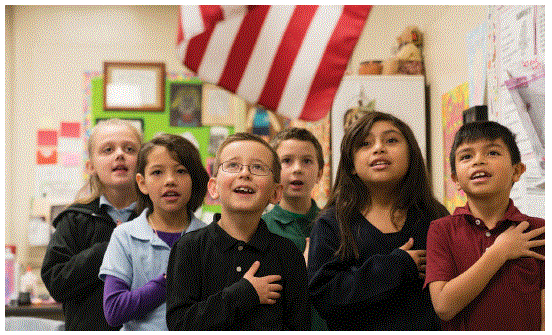
[Photo: Students recite the Pledge of Allegiance.]
Mostramos lealtad a la bandera y a los Estados Unidos cuando decimos el Juramento de Lealtad.
Durante las ceremonias de naturalización, se pide a todos los asistentes que digan el Juramento de Lealtad. Cuando lo decimos, nos ponemos de pie, nos volvemos hacia la bandera y ponemos nuestra mano derecha sobre nuestro corazón.
[Foto: Estudiantes recitan el Juramento de Lealtad.]
The National Anthem / El Himno Nacional
[p72]
The name of the national anthem is "The Star-Spangled Banner".[q123]
"Spangled" refers to the stars on the flag that look like they are shining in night sky. The word "banner" means flag.
The Star-Spangled Banner was written by Francis Scott Key. He wrote it about seeing the American flag after a battle during the War of 1812. The War of 1812 was one war the U.S. fought in the 1800s.[q91]
[Photo: In "The Star-Spangled Banner," by Percy Moran, Francis Scott Key reaches toward the flag flying over Fort McHenry.]
[p72]
El nombre del himno nacional es "The Star-Spangled Banner" (La Bandera Adornada de Estrellas).
"Spangled" se refiere a las estrellas en la bandera que parecen brillar en el cielo nocturno. La palabra "banner" significa bandera.
The Star-Spangled Banner fue escrita por Francis Scott Key. La escribió sobre ver la bandera americana después de una batalla durante la Guerra de 1812. La Guerra de 1812 fue una guerra que los Estados Unidos libraron en el siglo XIX.
[Foto: En "The Star-Spangled Banner", por Percy Moran, Francis Scott Key se extiende hacia la bandera que ondea sobre el Fuerte McHenry.]
AMERICAN HOLIDAYS / FERIADOS AMERICANOS
The following holidays are national holidays. National holidays are sometimes called "federal holidays" because they were passed by Congress and signed into law by the President.
The following federal holidays relate to other content from the 128 Civics Questions and Answers.[q126]
Los siguientes feriados son feriados nacionales. Los feriados nacionales a veces se llaman "feriados federales" porque fueron aprobados por el Congreso y firmados como ley por el Presidente.
Los siguientes feriados federales están relacionados con otro contenido de las 128 Preguntas y Respuestas de Educación Cívica.
Martin Luther King, Jr. Day (Third Monday in January) /
Día de Martin Luther King, Jr. (Tercer lunes de enero)
Martin Luther King, Jr. Day is a day that we honor the life and work of Martin Luther King, Jr.[q126]
Martin Luther King, Jr., was a church and community leader. He fought for civil rights[q113] by working to protect the rights of individuals listed in the Bill of Rights. For example, Martin Luther King, Jr. believed that everyone should have rights and freedoms listed in the First Amendment. The First Amendment protects freedom of worship, speech, the press, assembly, and the right to ask the government for a change.[q65]
Martin Luther King, Jr., led many of the events during the civil rights movement. The civil rights movement tried to end racial discrimination.[q113] In 1963, Martin Luther King, Jr., led the March on Washington for Jobs and Freedom. He gave his famous "I Have a Dream" speech in front of the Lincoln Memorial.
In 1965, Martin Luther King, Jr., and other civil rights leaders, like John Lewis, helped to organize a march from Selma, Alabama, to Montgomery, Alabama. They organized the march to support voting rights for all U.S. citizens. Soon after the march from Selma to Montgomery, Congress passed a law called the Voting Rights Act of 1965.
Martin Luther King, Jr., was awarded the Nobel Prize for Peace in 1964. He was assassinated on April 4, 1968.
The third Monday in January is Martin Luther King, Jr. Day. It is a national holiday.[q126] There is also a memorial in Washington, D.C., to honor him.
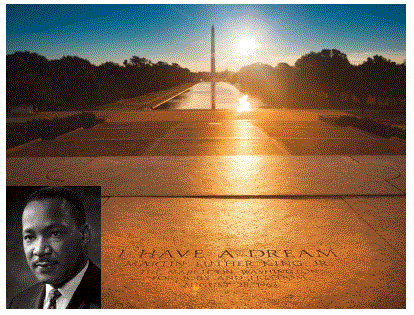
[Photo: Martin Luther King, Jr., gave his famous "I Have a Dream" speech at the Lincoln Memorial in 1963.]
El Día de Martin Luther King, Jr. es un día en que honramos la vida y el trabajo de Martin Luther King, Jr.
Martin Luther King, Jr., fue un líder religioso y comunitario. Luchó por los derechos civiles trabajando para proteger los derechos de las personas enumerados en la Declaración de Derechos. Por ejemplo, Martin Luther King, Jr. creía que todos deberían tener los derechos y libertades enumerados en la Primera Enmienda. La Primera Enmienda protege la libertad de culto, de expresión, de prensa, de reunión y el derecho a solicitar un cambio al gobierno.
Martin Luther King, Jr., lideró muchos de los eventos durante el movimiento por los derechos civiles. El movimiento por los derechos civiles intentó poner fin a la discriminación racial. En 1963, Martin Luther King, Jr., lideró la Marcha sobre Washington por Empleos y Libertad. Dio su famoso discurso "Tengo un Sueño" frente al Memorial de Lincoln.
En 1965, Martin Luther King, Jr., y otros líderes de los derechos civiles, como John Lewis, ayudaron a organizar una marcha desde Selma, Alabama, hasta Montgomery, Alabama. Organizaron la marcha para apoyar los derechos de voto para todos los ciudadanos de los Estados Unidos. Poco después de la marcha de Selma a Montgomery, el Congreso aprobó una ley llamada la Ley de Derechos de Voto de 1965.
Martin Luther King, Jr., recibió el Premio Nobel de la Paz en 1964. Fue asesinado el 4 de abril de 1968.
El tercer lunes de enero es el Día de Martin Luther King, Jr. Es un feriado nacional. También hay un memorial en Washington, D.C., en su honor.
[Foto: Martin Luther King, Jr., dio su famoso discurso "Tengo un Sueño" en el Memorial de Lincoln en 1963.]
Presidents' Day (Third Monday in February) / Día de los Presidentes (Tercer lunes de febrero)
[p73]
We celebrate Presidents' Day to honor George Washington and Abraham Lincoln.[q126]
George Washington was the first president of the United States. He is also called the "Father of Our Country". President Washington was born on February 22.[q86]
Abraham Lincoln was the 16th President of the United States. He led the United States during the Civil War. President Lincoln was born on February 12.[q94]
We celebrate Presidents' Day on the third Monday in February because it is between President Washington's birthday and President Lincoln's birthday.
[Photo: "George Washington at Princeton," by Charles Willson Peale. Courtesy of the U.S. Senate.]
[Photo: Abraham Lincoln. Courtesy of the Library of Congress.]
[p73]
Celebramos el Día de los Presidentes para honrar a George Washington y Abraham Lincoln.
George Washington fue el primer presidente de los Estados Unidos. También se le llama el "Padre de Nuestra Nación". El Presidente Washington nació el 22 de febrero.
Abraham Lincoln fue el 16.° Presidente de los Estados Unidos. Dirigió los Estados Unidos durante la Guerra Civil. El Presidente Lincoln nació el 12 de febrero.
Celebramos el Día de los Presidentes el tercer lunes de febrero porque cae entre el cumpleaños del Presidente Washington y el cumpleaños del Presidente Lincoln.
[Foto: "George Washington en Princeton", por Charles Willson Peale. Cortesía del Senado de los Estados Unidos.]
[Foto: Abraham Lincoln. Cortesía de la Biblioteca del Congreso.]
Memorial Day (Last Monday in May) / Día de los Caídos (Último lunes de mayo)
Memorial Day honors men and women who died in service to the United States. Memorial Day is the last Monday in May.[q127]
Memorial Day was originally called Decoration Day, from decorating graves with flowers, wreaths, and flags. People in the United States started to observe Memorial Day more widely soon after the Civil War. The Civil War was one war the U.S. fought in the 1800s.[q91]
Today, Memorial Day is a national holiday. It is commemorated at Arlington National Cemetery each year with a ceremony in which a small American flag is placed on each grave. We also fly the American flag at half-staff to honor those who died in service to the United States.
[Photo: Arlington National Cemetery.]
[Photo: A member of the U.S. Army honor guard walks past the Tomb of the Unknown Soldier at Arlington National Cemetery.]
El Día de los Caídos honra a los hombres y mujeres que murieron al servicio de los Estados Unidos. El Día de los Caídos es el último lunes de mayo.
El Día de los Caídos originalmente se llamaba el Día de la Decoración, por la costumbre de decorar las tumbas con flores, coronas y banderas. Las personas en los Estados Unidos comenzaron a observar el Día de los Caídos más ampliamente poco después de la Guerra Civil. La Guerra Civil fue una guerra que los Estados Unidos libraron en el siglo XIX.
Hoy, el Día de los Caídos es un feriado nacional. Se conmemora en el Cementerio Nacional de Arlington cada año con una ceremonia en la que se coloca una pequeña bandera americana en cada tumba. También ondeamos la bandera americana a media asta para honrar a quienes murieron al servicio de los Estados Unidos.
[Foto: Cementerio Nacional de Arlington.]
[Foto: Un miembro de la guardia de honor del Ejército de los Estados Unidos pasa frente a la Tumba del Soldado Desconocido en el Cementerio Nacional de Arlington.]
Juneteenth (June 19) / Juneteenth (19 de junio)
[p74]
Juneteenth is a national holiday[q126] that recognizes the end of slavery in the United States.
In 1863, President Abraham Lincoln issued the Emancipation Proclamation. The Emancipation Proclamation said the enslaved people in the Southern states were free.[q93] Slavery did not actually end until the Civil War ended in 1865. On June 19, 1865, enslaved people in Galveston, Texas, became the last to learn that they were free. This is why June 19th is called Juneteenth.
[p74]
Juneteenth es un feriado nacional que reconoce el fin de la esclavitud en los Estados Unidos.
En 1863, el Presidente Abraham Lincoln emitió la Proclamación de Emancipación. La Proclamación de Emancipación dijo que las personas esclavizadas en los estados del Sur eran libres. La esclavitud en realidad no terminó hasta que terminó la Guerra Civil en 1865. El 19 de junio de 1865, las personas esclavizadas en Galveston, Texas, fueron las últimas en enterarse de que eran libres. Por eso el 19 de junio se llama Juneteenth.
Independence Day (July 4) / Día de la Independencia (4 de julio)
Independence Day, or the Fourth of July, celebrates the Declaration of Independence, or the birth of the nation.
The Declaration of Independence announced America's independence from Britain.[q9] Thomas Jefferson wrote the Declaration of Independence[q78] as a statement of freedom from unfair treatment from Great Britain.[q87] The Declaration of Independence was adopted on July 4, 1776.[q79]
The Declaration of Independence highlights the importance of self-government in the United States. It also inspired many countries around the world to declare their own freedom.
Every year we celebrate Independence Day on July 4.[q125]
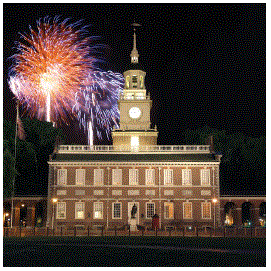
[Photo: Independence Day celebrations at Independence Hall in Philadelphia, Pennsylvania.]
[Photo: Military honor guard at a Veteran's Day parade.]
El Día de la Independencia, o el Cuatro de Julio, celebra la Declaración de Independencia, o el nacimiento de la nación.
La Declaración de Independencia anunció la independencia de América de Gran Bretaña. Thomas Jefferson escribió la Declaración de Independencia como una declaración de libertad del trato injusto de Gran Bretaña. La Declaración de Independencia fue adoptada el 4 de julio de 1776.
La Declaración de Independencia destaca la importancia del autogobierno en los Estados Unidos. También inspiró a muchos países del mundo a declarar su propia libertad.
Cada año celebramos el Día de la Independencia el 4 de julio.
[Foto: Celebraciones del Día de la Independencia en Independence Hall en Philadelphia, Pennsylvania.]
[Foto: Guardia de honor militar en un desfile del Día de los Veteranos.]
Veterans Day (November 11) / Día de los Veteranos (11 de noviembre)
[p75]
Veterans Day is a national holiday[q128] when we honor individuals who have served in the U.S. Armed Forces (alive or deceased) in service of the United States.
Veterans Day was originally called Armistice Day and celebrated the end of World War I, which ended on November 11, 1918. World War I is one war the U.S. fought in the 1900s.[q100] Woodrow Wilson was the President of the United States during World War I. Armistice Day was officially recognized by U.S. President Woodrow Wilson in 1919. It began to be observed throughout the world, honoring those who fought to end of the "Great War."
In 1954, U.S. veterans asked Congress to write a law that changed the name of Armistice Day to Veterans Day. The U.S. Congress makes federal laws.[q18] On June 1, 1954, Congress passed a law for Veterans Day to be a national holiday to honor men and women (alive or deceased) who have served in the U.S. military.
Today, we celebrate Veterans Day each year on November 11.
[Photo: "Raising the Flag on Iwo Jima," photographed by Joe Rosenthal. Courtesy of the Associated Press, 1945.]
[p75]
El Día de los Veteranos es un feriado nacional en el que honramos a las personas que han servido en las Fuerzas Armadas de los Estados Unidos (vivos o fallecidos) al servicio de los Estados Unidos.
El Día de los Veteranos originalmente se llamaba el Día del Armisticio y celebraba el fin de la Primera Guerra Mundial, que terminó el 11 de noviembre de 1918. La Primera Guerra Mundial es una guerra que los Estados Unidos libraron en el siglo XX. Woodrow Wilson fue el Presidente de los Estados Unidos durante la Primera Guerra Mundial. El Día del Armisticio fue reconocido oficialmente por el Presidente de los Estados Unidos Woodrow Wilson en 1919. Comenzó a observarse en todo el mundo, honrando a quienes lucharon para poner fin a la "Gran Guerra."
En 1954, los veteranos de los Estados Unidos pidieron al Congreso que escribiera una ley que cambiara el nombre del Día del Armisticio al Día de los Veteranos. El Congreso de los Estados Unidos hace las leyes federales. El 1 de junio de 1954, el Congreso aprobó una ley para que el Día de los Veteranos fuera un feriado nacional para honrar a los hombres y mujeres (vivos o fallecidos) que han servido en el ejército de los Estados Unidos.
Hoy, celebramos el Día de los Veteranos cada año el 11 de noviembre.
[Foto: "Izando la Bandera en Iwo Jima", fotografiado por Joe Rosenthal. Cortesía de Associated Press, 1945.]
Thanksgiving (Fourth Thursday in November) / Día de Acción de Gracias (Cuarto jueves de noviembre)
Thanksgiving is a national U.S. holiday[q126] that is celebrated on the fourth Thursday in November. Thanksgiving celebrates a harvest meal shared by Native Americans and English colonists in 1621. In November 1621, English colonists were trying to create a colony in Massachusetts. A Native American tribe called the Wampanoag gathered with the colonists in the fall for a harvest feast.
Today, the people in the United States gather with family and friends on Thanksgiving to share a meal and reflect on the reasons why they are thankful.
[Photo: An early Thanksgiving celebration.]
El Día de Acción de Gracias es un feriado nacional de los Estados Unidos que se celebra el cuarto jueves de noviembre. El Día de Acción de Gracias celebra una comida de cosecha compartida por Nativos Americanos y colonos ingleses en 1621. En noviembre de 1621, los colonos ingleses intentaban crear una colonia en Massachusetts. Una tribu de Nativos Americanos llamada los Wampanoag se reunió con los colonos en el otoño para un festín de cosecha.
Hoy, las personas en los Estados Unidos se reúnen con familia y amigos en el Día de Acción de Gracias para compartir una comida y reflexionar sobre las razones por las que están agradecidos.
[Foto: Una celebración temprana del Día de Acción de Gracias.]
U.S. Holidays[q126]
- New Year's Day (January 1).
- Birthday of Martin Luther King, Jr. (Third Monday in January).
- Washington's Birthday or Presidents' Day (Third Monday in February).
- Memorial Day (Last Monday in May).
- Juneteenth National Independence Day (June 19).
- Independence Day (July 4).
- Labor Day (First Monday in September).
- Columbus Day (Second Monday in October).
- Veterans Day (November 11).
- Thanksgiving Day (Fourth Thursday in November).
- Christmas Day (December 25).
Feriados de los Estados Unidos
- Año Nuevo (1 de enero).
- Cumpleaños de Martin Luther King, Jr. (Tercer lunes de enero).
- Cumpleaños de Washington o Día de los Presidentes (Tercer lunes de febrero).
- Día de los Caídos (Último lunes de mayo).
- Día Nacional de Independencia Juneteenth (19 de junio).
- Día de la Independencia (4 de julio).
- Día del Trabajo (Primer lunes de septiembre).
- Día de Colón (Segundo lunes de octubre).
- Día de los Veteranos (11 de noviembre).
- Día de Acción de Gracias (Cuarto jueves de noviembre).
- Día de Navidad (25 de diciembre).